


People Inc chairman Barry Diller believes the company has led the way on transitioning from Google dependence and is now building new revenue opportunities outside advertising and subscriptions.
People Inc has seen traffic to its brands referred by Google fall by 63% over the past two years.
But it is growing the amount of revenue that is not dependent on website visits.
This includes: advertising revenue from social media, events, its own AI-powered ad targeting product D/Cipher+, licensing revenue from Apple News and other content licensing (including with AI platforms).
This non-website income made up up 41% of People Inc digital revenue ($103m) in the first quarter of this year and saw 24% year-on-year growth in the first quarter of 2026. The publisher believes that will continue to grow “meaningfully” in the next quarters and years.
Session-based website revenue, including traditional direct-sold display and programmatic advertising, fell by 1% in Q1.
Speaking to investors on Tuesday, Diller said: “What publisher has navigated this transition anywhere close to how you have all navigated this?” referring to the C-suite leadership of People Inc.
Diller said publishers had been “serfs on the property and land of the monopoly of Google and this transition out of depending upon someone else to give you traffic, this is what every animal has done in this digital world for the last almost 20 years, and we have now transitioned out of it into true positive territory of our own traffic with our own hands, not dependent on anyone else.”
He said it was “incredible that no-one really recognises” the impact of that transition.
Diller added: “We don’t have to beg or borrow or get into endless conversations with the monopolist. And we’re really on our own firm ground, which is completely different than… every other publisher, other than The New York Times and The Wall Street Journal that have strong subscription revenue.”
Overall digital revenue for People Inc in Q1 increased by 8% year on year to $253m in the tenth consecutive quarter of growth.
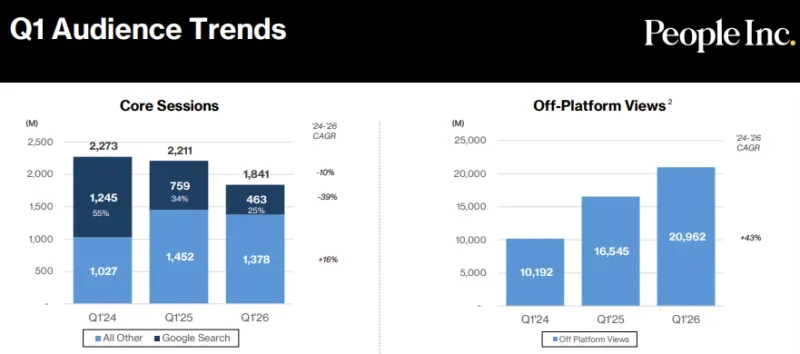
Off-platform views across platforms including Instagram, Tiktok, Youtube and Apple News, have increased 62% in the past two years.
Google search traffic now makes up 25% of core sessions at People Inc, down from 55% in Q1 2024 and 34% in Q1 2025.
AI Overviews now appear on almost 70% of the 10,000 top People Inc search keywords in Google.
Move away from evergreen content makes it more valuable to AI
People Inc has undergone a major pivot away from evergreen content towards reporting new information.
Chief executive Neil Vogel said this makes People Inc’s content even more valuable to AI companies doing deals.
He said there are two types of AI licensing deals, with People Inc’s agreements with Meta and OpenAI falling into the “all-you-can-eat” category and its deal with Microsoft in the “pay-per-use” marketplace camp.
Vogel said that since People Inc started blocking bots from scraping its websites, “we’ve entered into very productive discussions with all kinds of players, both expected and unexpected, in this market with the notable exception of Google”.
He said what was “really valuable” in today’s AI market is “new information. We make an awful lot of new information, and it’s really valuable to people. So I would expect we will have more to report on this in the future.”
Vogel also said AI efficiencies have helped People Inc create 50% more content than it was three years at the same cost and of higher quality.
People Inc is currently suing Google for compensation for revenue lost after the US Department of Justice successfully proved the tech giant had monopolised digital advertising markets and harmed its publishing customers.
People Inc projects the case will cost $15m this year and conclude in the first half of 2027.
Vogel said they “believe damages will be significant given our scale and level of participation in these markets”.
People Inc ‘Inversion’ strategy driving 19 new initiatives
People Inc is now focusing on a publishing strategy called Inversion, which Diller said includes 19 initiatives that have “nothing to do with standard advertising or subscription revenue.
“Out of this, I think we can build wholly owned, or partnered, extremely large businesses in all sorts of categories.”
Diller said that of People Inc’s 40 brands, of which about ten are seen as “significant” brands, “there is so much we know about so many things that no one actually else knows. And instead of being in the kind of tried and true publishing model of licensing your brands and licensing all this knowledge and all that stuff for other people to exploit, we’re going to exploit it.
“And out of that, I’d be giantly disappointed if we are not able to build real, substantial businesses, having nothing to do with advertising, having nothing to do with subscriptions, but having to do with goods, services, products, et cetera…”
He also said: “This is the fertile ground for dozens of businesses as we’re looking at this, because we got the intellectual property that can give us an edge in this that I think no one else has once we begin to concentrate on it, which is what we’ve started.”
Diller noted that People Inc still publishes 300 million print magazines a year and has billions of page impressions – meaning new products can be marketed “at not $1, really, additional cost to us”.
The Inversion initiatives include the People app, which launched last year backed by major investment and a 65-strong team and now has 430,000 users, Vogel said.
“The real win here is how we’re engaging people,” Vogel said. “A visit to the app is about three times as long as a visit to the web. If we get people playing games, which is the most popular thing on the app, it’s a 20 minute visit.”
Vogel also cited the launch of MyRecipes, which aggregates more than 100,000 published recipes from across People Inc titles onto one platform and has reached just over 3.5 million registered a year after launch.
Vogel claimed: “We’re probably more than half of the recipe traffic on the open web right now…
“I think the important thing to note about both MyRecipes and the People app, which have taught us how to engage users directly and all these new skills, is we have not gone outside our own assets at all to grow these things. And as we roll out and as we tighten up financial models around these that’s a really big opportunity.”
Vogel also referenced the “breakout hit” on InStyle which launched two social video series with episodes just a few minutes long each: The Intern and The Boss. The Intern has received 45 million views in a year and become a “robust” sponsor business, he said.
Vogel said the combination of brand strength, audience size and reach and the data it has about those audiences means People Inc can control its own destiny and sell non website based advertising at “really attractive rates”.
Adjusted print earnings (EBITDA) was down 55% to $6m in Q1 but chief financial officer Tim Quinn said it is still expected to cover People Inc’s corporate overhead costs in the full year (excluding Google litigation costs).
Digital adjusted EBITDA was up 20% to $50m in the quarter.
Parent company IAC announced last week it will change its name to People Incorporated and merge its necessary corporate staff (less than half) into People Inc as it concentrates on the publishing business and its 26% stake in MGM Resorts. It sold care marketplace platform Care.com for about $320m earlier this year.
This is expected to generate annual savings of $40m and around $20-$25m in reduced stock-based compensation expense.
The Daily Beast, which is separate from People Inc in the financial statements, grew revenue by 36% year on year in Q1 (to a combined $20m with healthcare platform Vivian Health). Both brands also increased profits.
[Read more: Daily Beast makes subscriptions ‘core focus’ of revenue growth]
Email pged@pressgazette.co.uk to point out mistakes, provide story tips or send in a letter for publication on our "Letters Page" blog
